Underwater friendships
MARE
A freediver who has returned to the same rocks for decades on groupers that stop fleeing, octopus that would never stop playing, and sea stars that learn to trust him.
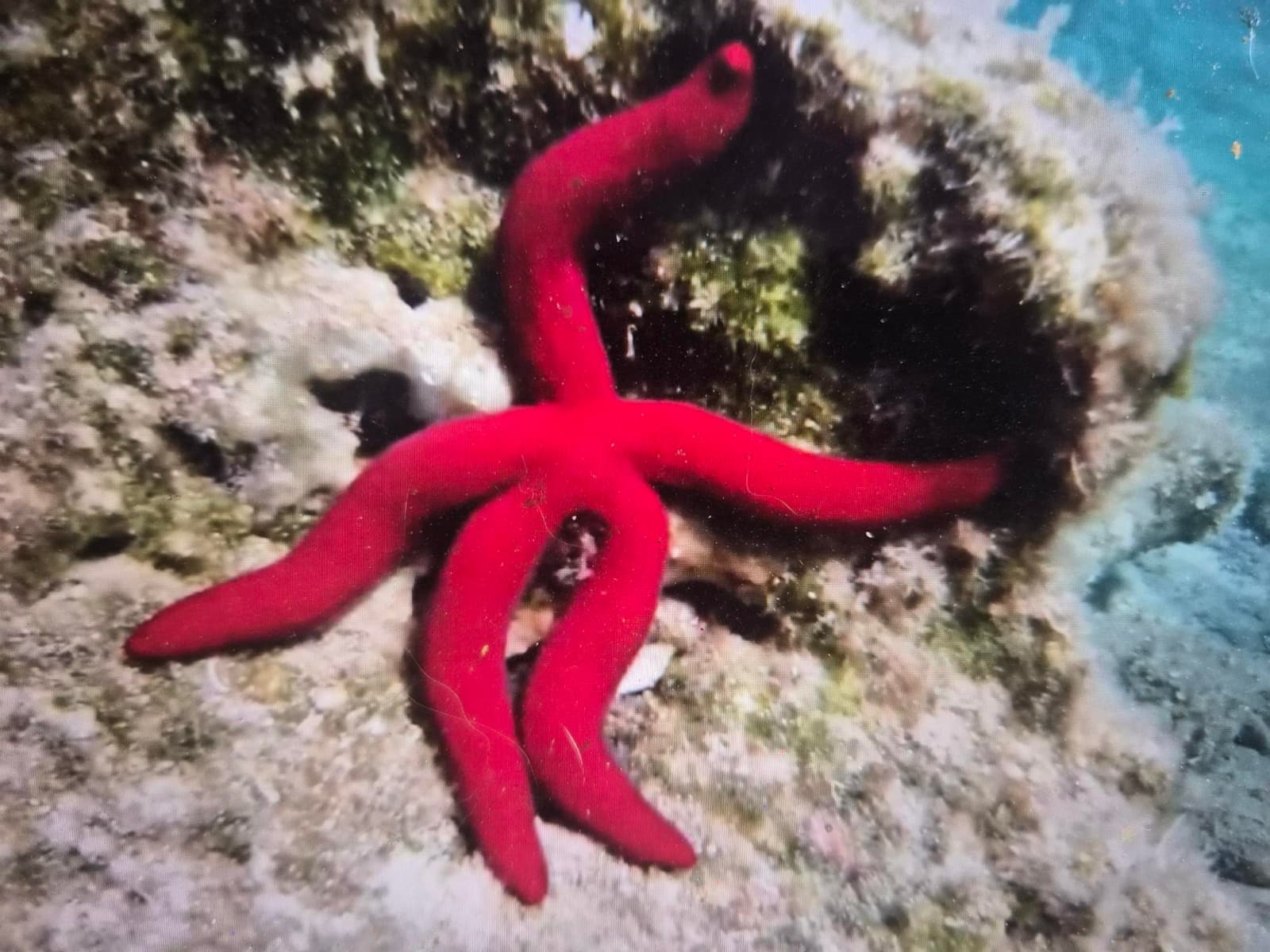 Photo by the author
Dear Friends,
I would like to share something important with you: FRIENDSHIP.
I consider you Friends too, because if you love Elba we have a passion in common, and you will probably understand me.
Almost every day I feel the need to get into our water. I take my little boat, sometimes for no more than half an hour stolen from work, and I go and visit some Friends I have come to know, underwater.
I am a modest freediver, but we are lucky enough to live somewhere where it is easy to meet pelagic fish, amberjack, dentex and much more. Beautiful fish, but their presence depends on many things: currents, seasons and so on. My real Friends are therefore rather more intimate and settled: corb, moray eels, groupers, octopus and sea stars too.
The last three in particular are my favourite Friends.
They move around too, and they have their seasonal habits, but once you learn to know them it is easier to find them again every day and to build a relationship.
In recent years the groupers have increased and have come back to live on our seabeds, even in shallow water. But groupers are voracious predators, and the octopus pay for it — already subject to indiscriminate fishing, and much reduced.
Groupers and octopus are both curious, and once the initial wariness is over they become very sociable.
To make friends with them all it takes is a little good food, a few polite visits to their home, and that is that!
The secret is to always wear the same mask, the same fins, if possible the same swimming costume, and not to be too intrusive. The first few times it also matters to come at more or less the same hour; later the food is no longer needed, Friendship is enough.
When I arrive near their dens, as soon as they recognise me they come out, happy, to socialise.
And octopus, once they grow fond of you, are the sweetest things, and would never want to stop playing.
Sadly I sometimes find the dens torn apart, with clear signs of human intrusion. Once I even saw a dear Friend looking at me, tangled on the spear of a tourist carrying him to the surface. I could have cried. I was depressed for a week.
Crocodile tears, because then at the restaurant I will happily eat a tentacle myself — just not my Friend's!!! And if I think that as a boy octopus fishing was my speciality… In short, I realise I am a total hypocrite, but there it is!
In the end fishing was, for me, the way to love and understand the Sea, where everyone is a predator, ourselves included, but we can be one with respect and balance.
But let us come to the Sea Stars, which are also in decline. I adore them all but, among the various species, on Elba there is also a large one that is literally marvellous: the Serpent Sea Star (Ophidiaster ophidianus).
Despite a name that may sound threatening, the Serpent Sea Star is completely harmless, beautiful, and it takes my heart.
These are stars that are not so rare, for anyone who knows how to look, and not to be confused with the commoner and smaller Red Sea Stars (Echinaster sepositus). Adult Serpent Sea Stars average 35 to 40 cm across, but some specimens reach 50 cm and beyond. They have magnificent colours, from deep red to violet and all the way to blue, but also yellow, orange or mottled; they are a spectacle.
These sea stars are intelligent, sensitive creatures; they move about with a certain ease and they are extraordinary predators. Although they have been studied, some things about them remain mysterious, such as how long they live: some say around 35 years, others maintain they can reach 60.
It is now known that sea stars have reasonable eyesight and feel emotion. When I find new ones, if I come too close they take fright and then move elsewhere; but if I keep visiting them without shifting them or handling them improperly, in time they learn to trust.
Some of these Friends I have been visiting for decades. I have watched them grow, because I have a good many years on me too.
Serpent Sea Stars are a protected species; fortunately they are not good to eat and they generally stay hidden in their dens. But when they go hunting, or look for a little light, along comes some fool who finds them and cannot resist taking the trophy home. They have no idea of the damage they do!
The real problem, though, is the specialised poachers who take them wholesale at night with torches and tanks, and sell them to private aquariums or for decoration. This year too I have lost beautiful Friends I was fond of.
Others sense the danger, and vanish, or move to another spot. Sometimes I am anxious for weeks — but when I finally find them again, for me it is a joy.
And the Friendship goes on.
— MARE
Written in Italian. This is our translation.
Also published inElba PressElba Report